
Determining the value of points can be a highly subjective exercise, where people arrive at wildly different numbers. With the increasing popularity of transferable points currencies over the years, deciding on the value of points has become even more challenging, with people arriving at wildly different valuations.
In this post I wanted to share how I come up with the valuation for one of my favorite points currencies, Chase Ultimate Rewards.
Why I Think Ultimate Rewards Points Are Worth 1.7 Cents Each
Chase Ultimate Rewards points are one of the most valuable and widely collected points currencies out there. Personally, I’ve long stated that I value Ultimate Rewards points at roughly 1.7 cents each, and I’ve received a lot of questions over the years about how I come up with that valuation. In this post I wanted to take a closer look at how I arrived at that number.
There’s No Correct Valuation For Points
Let me start by saying that while I believe there’s a right and wrong way to go about valuing points, there’s not actually a widely agreed upon valuation of points.
Just as I say that Ultimate Rewards points are worth 1.7 cents each, some may say that they’re worth 1.5 cents each, while others may say that they’re worth 2.0 cents each. They’re not necessarily any more right or wrong than I am.
General Approach To Valuing Points
A while back Travis wrote a series explaining how to value points based on your earning and redemption patterns. He’s much more of a scientific thinker than I am, so check out his series:
- Miles Aren’t Free: How To Value Your Redemptions
- Miles Aren’t Free: How To Value What You Earn
- Miles Aren’t Free: Establishing An Overall Value
The simplest way to explain it is that points are worth some amount between your acquisition cost and your redemption value. Where in that range your valuation falls depends entirely on how you choose to redeem points. With credit card points the acquisition cost math gets murky, since you have to view that in terms of the opportunity cost of earning those points (for example, how much cash back could you otherwise earn with another credit card?).
In a simple diagram, here’s how he explained his methodology for valuing points:
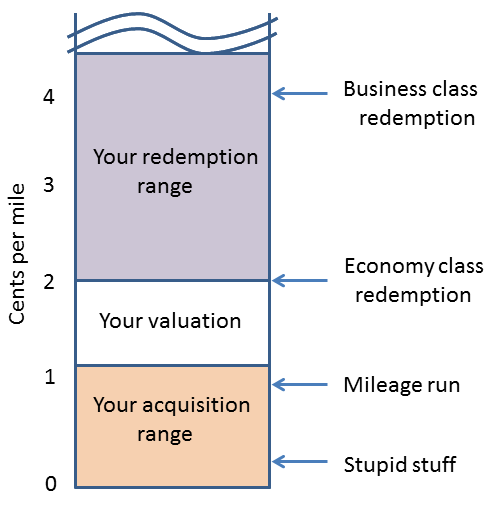
With airline miles you’ll typically get the most value out of first & business class redemptions, though transferable points currencies give you a bit more flexibility in terms of the ways you can redeem while optimizing your points.
If you are going to redeem points for a first or business class ticket, personally I think you can only value miles based on how much you’d otherwise be willing to pay for that ticket, rather than how much the ticket costs in cash.
If you redeem 100,000 miles for a ticket that would cost $10,000 in cash, you’re not actually getting 10 cents per mile of value, assuming you wouldn’t have paid that in cash. Instead the real value you’re getting is how much you otherwise would have been willing to pay for the ticket. At least that’s how I recommend approaching it when valuing points.
Other people disagree with my logic and would suggest that they are in fact getting 10 cents of value per point in the above scenario. While I understand the logic, I’d ask those people if they’d be willing to buy Ultimate Rewards points for nine cents each in that case (you can’t actually buy them, so this is theoretical, but still…).
So if you want to argue that you’re getting 43 cents of value per Ultimate Rewards points (or something) I’m not going to tell you you’re wrong, though I also think that “valuation” isn’t terribly useful.
The Two Best Ways To Redeem Ultimate Rewards Points
In the case of Ultimate Rewards points, there are two “optimal” ways to redeem these points that have to be considered when coming up with a value:
Redeem Points As Cash Towards Travel
Ultimate Rewards points can be redeemed as cash towards the cost of a travel purchase, including for things like flights, hotels, car rentals, and more. The amount of value you get per point varies based on the most premium card you have:
- If you have the Chase Sapphire Reserve® Card, you can redeem points for 1.5 cents each towards the cost of a travel purchase
- If you have the Chase Sapphire Preferred® Card or Ink Business Preferred℠ Credit Card, you can redeem points for 1.25 cents each towards the cost of a travel purchase
It’s not just about which card you’re earning points with, but rather about which card is the most premium, since you can transfer points between accounts. So if you have the Chase Sapphire Reserve and Ink Business Preferred, all points can be redeemed for 1.5 cents each towards the cost of a travel purchase.
As you can see, this establishes a base value of 1.25-1.5 cents per Ultimate Rewards point, depending on which card you have.

Redeem points for 1.5 cents each towards the cost of a travel purchase
Transfer Points To An Airline Or Hotel Partner
The other way you can redeem your Ultimate Rewards points is to transfer them to one of the Chase Ultimate Rewards airline or hotel partners.
All three cards earning premium Ultimate Rewards points have the ability to transfer points to these 13 partners, which include 10 airline programs and three hotel programs:
| Airlines | Hotels |
|---|---|
| Aer Lingus Aer Club | IHG Rewards Club |
| Air France/KLM Flying Blue | Marriott Bonvoy |
| British Airways Executive Club | World Of Hyatt |
| Emirates Skywards | |
| Iberia Plus | |
| JetBlue TrueBlue | |
| Singapore KrisFlyer | |
| Southwest Airlines Rapid Rewards | |
| United MileagePlus | |
| Virgin Atlantic Flying Club |
In deciding the value of Ultimate Rewards points, we have to decide the value of the points currencies you can transfer to. Personally my valuations of these points are roughly as follows:
| Ultimate Rewards Transfer Partner | Transfer Ratio | Value Of Points |
|---|---|---|
| Aer Lingus Aer Club | 1000 : 1000 | 1.3 cents |
| Air France KLM FlyingBlue | 1000 : 1000 | 1.3 cents |
| British Airways Executive Club | 1000 : 1000 | 1.3 cents |
| Emirates Skywards | 1000 : 1000 | 1.0 cents |
| Iberia Plus | 1000 : 1000 | 1.3 cents |
| JetBlue TrueBlue | 1000 : 1000 | 1.3 cents |
| Singapore Airlines KrisFlyer | 1000 : 1000 | 1.4 cents |
| Southwest Rapid Rewards | 1000 : 1000 | 1.3 cents |
| United MileagePlus | 1000 : 1000 | 1.4 cents |
| Virgin Atlantic Flying Club | 1000 : 1000 | 1.2 cents |
| IHG Rewards Club | 1000 : 1000 | 0.5 cents |
| Marriott Rewards | 1000 : 1000 | 0.7 cents |
| World Of Hyatt | 1000 : 1000 | 1.5 cents |

Transfer points to World of Hyatt for redemptions at the Park Hyatt Maldives
How Can Points Be Worth More Than Any Individual Redemption Opportunity?
You might be saying to yourself “well wait a second, how can Ultimate Rewards points be worth 1.7 cents each, when the most you value any of the individual redemption opportunities with the Chase Sapphire Reserve® Card is 1.5 cents per point?”
Some may disagree with my approach here, though let me first say that I intentionally value points very conservatively, much more so than many. That’s because every time I decide whether to pay cash or redeem points for something I crunch the numbers, and I don’t want to establish a value where I create an unrealistic expectation of points.
So how can I value Ultimate Rewards points more than any of the individual currencies you can redeem the points for? Because one aspect of my valuing points is applying a discount to account for the fact that they’re prone to devaluations:
- If you’re collecting a specific points currency, the value of your points can decrease significantly overnight
- If you’re collecting a transferable points currency, you have a ton more flexibility, and therefore I think it’s only reasonable to apply a premium to the points, in this case of a bit over 10%
Simply put, I value an Ultimate Rewards point more than any of the individual redemption options because I’d rather hold onto flexible Ultimate Rewards points than points with a particular partner, and I need to account for that in my valuation.
The valuation of a particular points currency isn’t based on the absolute most value you can get out of those points, but rather is based on an achievable redemption that takes into account the decreasing value of points over time.
That’s to say that I could get more than 1.5 cents of value per World of Hyatt point, but that’s a “conservative” valuation of those points. Therefore it seems logical that I’d value Ultimate Rewards points higher, since those points give me even more redemption options and flexibility.

Transfer Ultimate Rewards points to KrisFlyer for redemptions in Singapore Airlines first class
What Does That Mean For Cards Earning Ultimate Rewards Points?
Given my valuation of 1.7 cents per point, what does this mean for the return on spending offered by the major cards earning Ultimate Rewards points?
- The Chase Sapphire Reserve® offers 3x points on dining and travel (5.1% return)
- The Chase Sapphire Preferred® offers 2x points on dining and travel (3.4% return)
- The Ink Business Preferred℠ offers 3x points on the first $150,000 spent in combined purchases per account anniversary year on travel, shipping purchases, internet, cable, and phone services, and advertising purchases with social media sites and search engine (5.1% return)
- The Ink Business Cash℠ Credit Card offers 5x points on the first $25,000 spent in combined purchases per account anniversary year at office supply stores, and on internet, cable, and phone services (8.5% return), as well as 2x points on the first $25,000 of combined purchases per account anniversary year at restaurants and gas stations (3.4% return)
- The Chase Freedom Unlimited® offers 1.5x points on everyday spending (2.55% return)
- The Chase Freedom® Card offers 5x points in rotating quarterly categories on up to $1,500 of spending per quarter (8.5% return)
As you can see, those are some impressive returns.
On personal cards, it’s tough to beat the combination of the Sapphire Reserve and Freedom Unlimited, and for business cards both the Ink Preferred and Ink Cash offer some valuable bonus categories.
Ultimate Rewards Value Summary
There’s no objective valuation of points that everyone will agree on. Rather I try to provide general guidance as to how I value points, noting that everyone will redeem their points differently, and get different value out of them.
With that in mind, I like to value points conservatively, because I don’t want to create unrealistic expectations, and then have people hoarding points they’ll never get a good value out of.
Personally 1.7 cents per Ultimate Rewards point is a value I’ve long felt good about, and continue to feel good about. By my logic:
- Redeeming Ultimate Rewards points for 1.5 cents each towards a travel purchase isn’t an ideal redemption, though others can value the points slightly less and find this to be a great redemption
- While I don’t value the points of any individual transfer partner at 1.7 cents, I intentionally value Ultimate Rewards points at a premium, due to their flexibility
I’m curious to see how my valuation of Ultimate Rewards points compares to how you guys value them.
What do you think — how much are Ultimate Rewards points worth?
The post How Much Are Ultimate Rewards Points Worth? (2019) appeared first on One Mile at a Time





0 Comments